There was a time when social media felt like a meeting place.
Writers would share what they were working on. Readers would talk about books they loved. Someone would post about a stubborn plot problem and half a dozen people might jump in with encouragement or suggestions. It was never perfect, but there was a sense that people were there because they genuinely cared about books and the people who wrote them.
Lately, though, the tone of those interactions has changed, especially in private messages.
The shift is subtle. The pitch no longer arrives as a pitch. Instead, it arrives disguised as a conversation.
You receive a friendly message. Someone thanks you for the follow. They ask how writing is going. The exchange feels normal enough that you respond the way you would to any other writer.
Then the conversation continues. A few questions about your work. A little small talk. Maybe even a compliment or two. And somewhere along the way you begin to realize that the conversation is not really a conversation at all.
It is the slow beginning of a sales funnel.
The frustrating part is not that someone eventually wants to sell something. Writers understand the reality of marketing better than most people. The frustration comes from the time spent getting there. By the time the real purpose appears, you have already given away several minutes that could have been spent writing the next paragraph of your book.
Over time, many indie authors began responding to this pattern by setting a clear boundary. It became common to see some version of “No marketing DMs” in an author’s bio.
For a while, that helped. Then the tactic changed.
Instead of approaching authors openly as marketers, some accounts began approaching them as fellow writers. The conversation would begin naturally and stay that way for a while. Only later would the marketing angle appear.
In other words, the pitch stopped arriving at the door. It started arriving inside a Trojan horse.
After encountering this pattern more than a few times, I decided to take a slightly different approach when someone reached out. In one case, the person messaging me identified themselves as a book marketer in their profile, so I chose to be upfront right away.
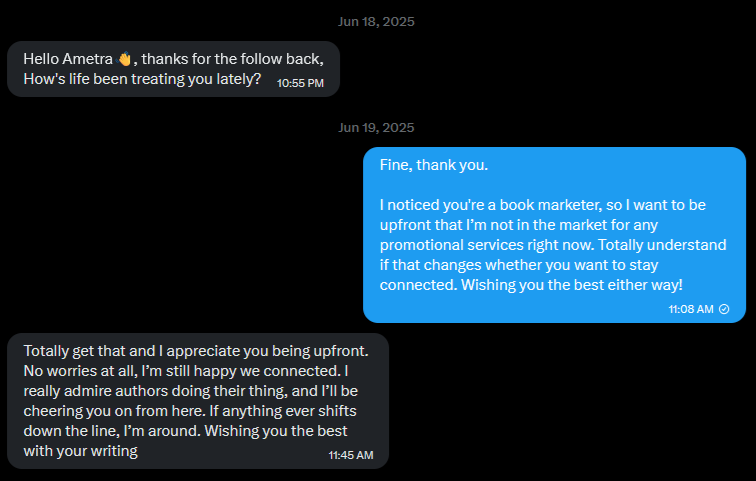
I explained politely that I was not in the market for promotional services and wanted to be transparent about that from the beginning. To their credit, the response was gracious. They appreciated the honesty and wished me well with my writing.
That exchange stood out precisely because it was respectful and straightforward. No pressure. No attempt to steer the conversation somewhere else. Just a polite acknowledgement and a natural end to the interaction.
Encounters like this remind me that professionalism still exists online, even though there’s the tendency to ignore the clear aversion to marketing DMs in my bio.
Unfortunately, this sort of smooth exchange is not the majority of what shows up in author DMs. More often, the conversation unfolds slowly. The person asks about your current project. They ask whether the book you mentioned is your debut. They ask what your previous books are about.
On the surface, it reads like a perfectly normal exchange between writers.
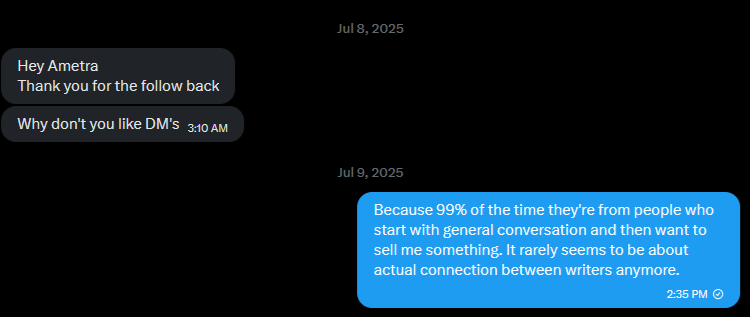
This is where the modern pitch hides. It takes its time. It builds familiarity first. It allows the conversation to feel organic before eventually pivoting toward marketing services or promotional opportunities.
Nothing about it is aggressive. Nothing about it is overt. It is simply time consuming, and when this happens again and again, the pattern becomes hard to ignore. A message that begins with casual curiosity about your writing often turns out to be the opening move in a script.
There is another variation of this pattern that is even more unsettling.
Sometimes the person messaging you presents themselves as an author. Not just any author, but one whose name might already be familiar. At first glance, the interaction seems flattering. A fellow writer is reaching out to talk about your work.
But small details start to feel slightly off.
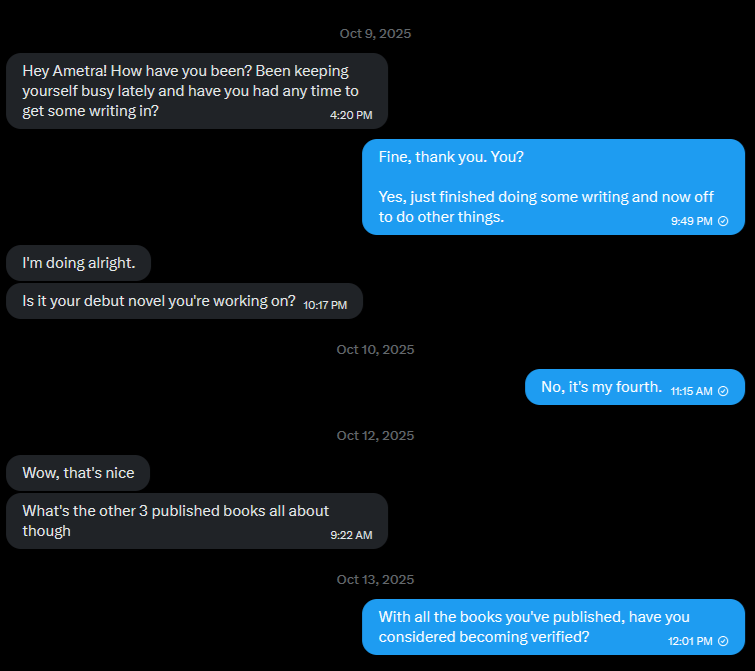
In this case, a single question brought the conversation to a halt. I asked why the account was not verified.
The message was never answered.
After looking a little closer at the account, it became clear that the person behind it was not the author they claimed to be. The account was simply borrowing the identity in order to gain trust before eventually steering the conversation toward something else.
Being left on read turned out to be the answer.
Did I abruptly change the subject? Yes. Could it have been considered rude? Sure. Do I care? Not so much. None of what I said or how I responded changes the fact that the person reaching out to me was misrepresenting themselves, and I was probably being set up for the long game sales pitch.
Moments like that make it clear why so many writers are growing weary of private messages on social platforms. What used to feel like a space for connection now sometimes feels like a space where conversations are quietly guided toward a transaction.
There is nothing wrong with offering services. Writers often need help with marketing, design, editing, and many other parts of the publishing process.
But transparency matters.
When someone approaches you honestly and says what they do, it leaves room for a respectful yes or no. When the intention hides behind a prolonged conversation, it slowly erodes trust in the very thing social media was supposed to encourage.
The irony is that many writers would happily talk with other writers all day about books, characters, and the strange joys of the creative process. That kind of connection is still one of the best parts of being part of the writing community. But when every friendly greeting starts to feel like the beginning of a pitch, it becomes easier to avoid the conversation entirely.
And if I am being honest, I would much rather spend my time wrestling with a stubborn plot hole than wondering whether the person in my DMs is genuinely interested in books or simply interested in selling something.
At least the plot hole is honest about what it is.
I wrote about this idea in more depth in a previous post, More Than a Product: What Authors Really Need from Marketers, where I talked about the difference between selling a service and supporting a creative career. The distinction may seem small, but for writers it makes all the difference.
Most of us are not looking for clever funnels or carefully staged conversations.
We are simply looking for people who approach the work with the same kind of sincerity we bring to the page.
And if that happens, a conversation can remain what it was meant to be all along.
A conversation.
xo Ametra.
P.S. At this rate, my next post may need to feature a “Best Of” collection from my DMs.
